
Executive Summary
Generative Artificial Intelligence (Gen AI) has transitioned from experimental curiosity to a primary driver of enterprise performance. Organizations that successfully integrate Gen AI into their “digital core” report significant measurable returns, including an average ROI of 1.7x and up to 2.5x higher revenue growth compared to peers with low operational readiness. However, the path to value is hindered by foundational hurdles: only 16% of organizations are currently “reinvention-ready,” and a mere 4% of enterprises have data ready for ingestion by AI models.
The critical takeaway for leadership is that Gen AI value is maximized through augmentation rather than simple automation. By focusing on “agentic AI”—digital workers that take action alongside humans—businesses can realize productivity gains of 25% and improvements in work quality of 40%. Success requires a dual focus on modernizing data infrastructure and upskilling the workforce to move beyond “pilot purgatory” toward production-scale deployment.
I. Business Impact and Economic Potential
Generative AI is projected to add between $2.6 trillion and $4.4 trillion annually to the global economy. Within the enterprise, the impact is characterized by increased efficiency, faster decision-making, and significant cost savings.
Key Performance Metrics
- Productivity and Quality: Studies indicate a 25% increase in productivity for knowledge-based activities and a 40% improvement in the quality of creative and analytical outputs.
- Operational Readiness: “Reinvention-ready” organizations are 3.3x more likely to successfully scale high-value Gen AI use cases.
- Cost Reduction: AI is reshaping core functions to deliver cost savings of 26% to 31% across supply chains, procurement, and finance.
- Revenue Growth: Mature organizations reported 2.5x higher average revenue growth between 2019 and 2023 by leveraging tech-led reinvention.
“At some point, you’re going to have to [act]. I think we’re at the phase now where we’ve learned enough, and I think it’s now about putting your money where your mouth is.” — Bhavesh Dayalji, Chief AI Officer, S&P Global
II. Core Strategies for Leveraging Generative AI
Experts identify several essential strategies to unlock the potential of Gen AI while avoiding common implementation pitfalls.
1. Focus on Augmentation and “Agentic AI”
The current phase of adoption is moving toward the “autonomous enterprise.” Rather than just creating content, “agentic AI” systems go beyond software assistants to become digital employees that perform work alongside humans.
- Copilots: Integrated assistants (e.g., Microsoft 365 Copilot) can research, write, and summarize, with users reporting 29% higher productivity.
- Agents: Salesforce estimates it will have a billion AI “agents” within a year, focusing on reducing waste and tackling operational inefficiencies.
2. The “WINS” Work Framework
Businesses should prioritize Gen AI for tasks and industries dependent on the manipulation and interpretation of four key data types:
- Words (Text generation, translation, coding)
- Images (Product design, 3D modeling, infographics)
- Numbers (Data analysis, fraud detection, risk evaluation)
- Sounds (Transcription, voice recognition, sound editing)
3. Move Beyond “Pilot Purgatory”
To capture long-term value, businesses must avoid the trap of disconnected experiments. This involves:
- Making Big Bets: Focusing on a few high-impact initiatives aligned with strategic goals rather than “chasing every shiny opportunity.”
- Business and IT Co-ownership: Roadmaps must be created jointly by tech and business teams, led by the CEO, to ensure alignment with operational outcomes.
III. Foundational Requirements: Data and Infrastructure
The most significant barrier to scaling AI is the “digital core”—the underlying data and systems architecture of the company.
The Data Readiness Gap
- Infrastructure Assessment: Most AI projects fail or stall because they are actually data projects in disguise. Legacy systems and siloed data formats prevent models from accessing the information they need.
- Structured vs. Unstructured Data: Current AI models struggle to effectively query structured data (databases/SQL). Connecting large language models (LLMs) to proprietary enterprise data is the primary differentiator for competitive advantage.
Criteria for Reinvention-Ready Operations
“Every AI project begins and ends, or lives, as a data project, so infrastructure assessment… is key to your success.” — Vala Afshar, Chief Digital Evangelist, Salesforce
IV. The Human Dimension: Talent and Education
Successful integration requires a culture shift and a “talent-first” strategy. Organizations must balance technical advancement with the unique capabilities of human workers.
Evolving Skillsets
- Prompt Engineering: Being able to “ask a question really, really well” is a critical new capability. Experts note that “the hottest new programming language now is English.”
- Human Qualities: Curiosity, healthy skepticism, empathy, and critical thinking remain uniquely human and essential for overseeing AI outputs.
- Upskilling: Organizations must provide comprehensive training as 44% of employee skills are expected to be disrupted in the next five years.
Addressing Job Security and Trust
While 80% of workers may see at least 10% of their tasks impacted by LLMs, the overall effect on job growth is predicted to be a net positive. The focus should be on “human-in-the-loop” systems where AI handles repetitive data tasks, freeing humans for strategic and creative inquiry.
V. Cross-Industry Applications
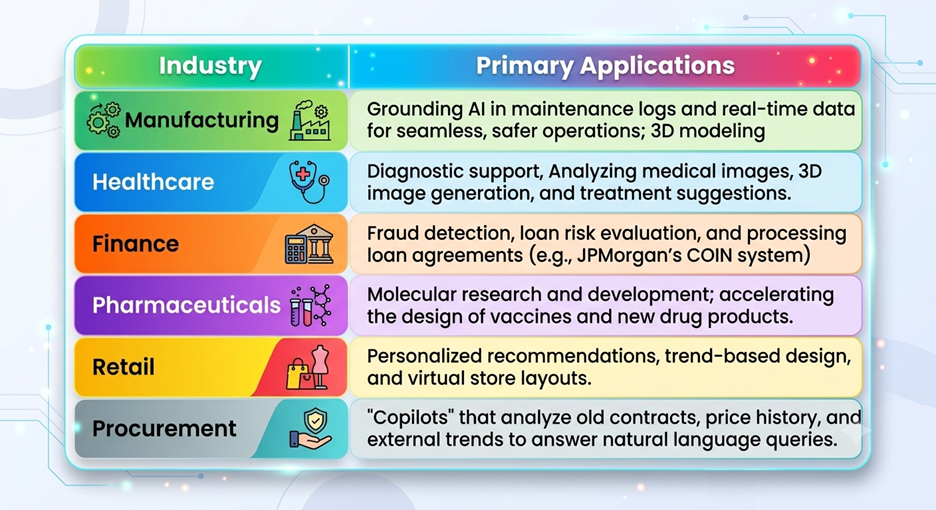
Generative AI is transforming various sectors by either cutting waste, unlocking creativity, or accelerating decision-making.
VI. Risks, Limitations, and Ethics
Leadership must be aware of the inherent drawbacks of probabilistic models to avoid operational and legal pitfalls.
- Hallucinations: AI models are not “causal engines”; they are probabilistic and can generate false information that appears plausible. All outputs require human oversight.
- Model Bias: AI trained on public internet data can mirror societal biases. Organizations need internal policies to filter and analyze outputs for prejudice.
- IP and Legal Risks: There is ongoing uncertainty regarding the ownership of AI-generated content (e.g., code or creative work). Data entered into public tools may also become public information, necessitating strict privacy controls.
- Sustainability: Generative AI requires significant energy. Organizations should prioritize use cases to manage power consumption and utilize renewable energy where possible.
“You need oversight by a human. You can’t de facto trust what the machine tells you.” — Soumya Seetharam, SVP and CDIO, Corning