

The Modern Mandate for Intelligent Automation
In the current enterprise landscape, the strategic shift from simple task automation to end-to-end intelligent orchestration has transitioned from a competitive advantage to a foundational infrastructure for growth. Traditional automation often focused on siloed, repetitive tasks; however, modern orchestration integrates disparate systems, data, and AI reasoning into a cohesive operational engine. For the Enterprise Architect, automation is no longer a “nice-to-have” feature—it is the underlying framework required to eliminate process bottlenecks and enforce consistent governance across the digital estate.
Market Dynamics and the Economic Imperative The economic motivation for this transition is supported by significant market data and research:
- Operational Potential: McKinsey estimates that roughly 45% of current work activities can be automated, with data collection and processing representing the largest opportunities for efficiency gains.
- Cycle-Time Reduction: Forrester research indicates that companies deploying workflow automation for routing and approvals have reduced cycle times by 50–80%, particularly in finance and HR departments.
- Market Growth: The global business process automation market, valued at $14.2 billion in 2023, is projected to grow at a CAGR of 12% through 2030, fueled by the expansion of API-native and no-code platforms.
The Paradigm Shift: From Rules to Agents The industry is undergoing a fundamental pivot away from purely “rule-based” systems—which rely on rigid, deterministic “If X, then Y” logic—toward agentic orchestration. Gartner reports a staggering 1,445% surge in client inquiries regarding multi-agent systems that collaborate to complete complex workflows. While traditional tools can move data, they cannot reason across unstructured inputs or adapt to variable conditions. Business tools alone cannot deliver true automation because they lack a dedicated orchestration layer to bridge data silos and coordinate handoffs across the entire enterprise stack.
Understanding this shift requires a granular examination of the fundamental building blocks that constitute a robust, intelligent system.
Foundational Anatomy: The Trigger-Condition-Action Mechanics
Every reliable workflow—regardless of its complexity or the sophistication of the AI models involved—relies on a core structural pattern. Architectural clarity is the prerequisite for robustness; without a defined structure, automation simply accelerates the propagation of errors.
The Core Layer: Foundations of Execution The most basic anatomy of an automated workflow is defined by three foundational layers:
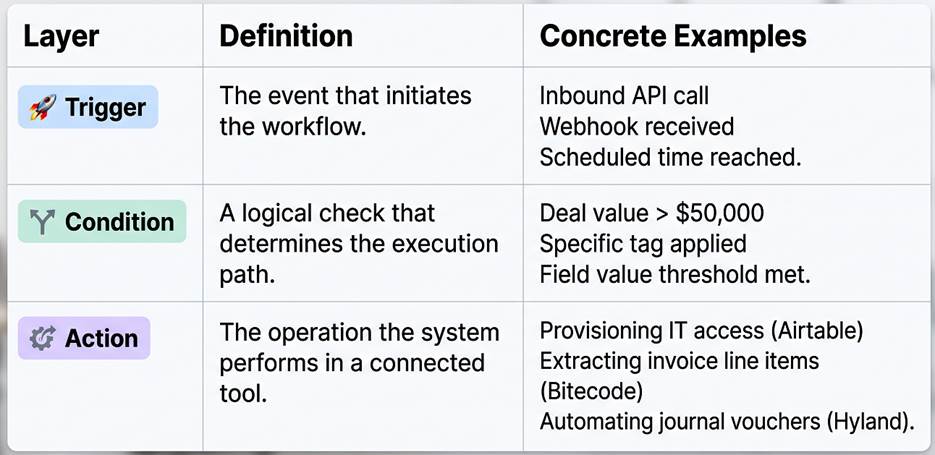
The 7-Node Orchestration Stack Beyond basic mechanics, enterprise-grade orchestration utilizes a standard 7-node anatomy to manage complex decision chains:
- Trigger: The specific event payload entering the system.
- Ingestion & Preprocessing: Fetching, cleaning, and normalizing data to remediate “data-quality debt.”
- AI/Model Nodes: The inference step where models classify intent, summarize, or extract data.
- Orchestration Engine: The runtime that sequences nodes and manages the workflow state.
- Rules & Branching: Deterministic logic that routes execution based on model outputs.
- Integrations: API-native connectors to external platforms (ERPs, CRMs, Databases).
- Monitoring: Capturing execution traces, latency, and confidence scores for observability.
Differentiating the Automation Stack Selecting the right architecture requires understanding how technologies interact with the underlying stack. For the Architect, the distinction between API-native orchestration and UI-based mimicry is critical for long-term stability.
| Dimension | Workflow Automation | Robotic Process Automation (RPA) | Business Process Management (BPM) |
| Operating Layer | API / Process Layer | UI / Presentation Layer | Governance / Strategic Layer |
| Technical Stack | Native connectors & REST APIs | Bots mimicking human clicks | Centralized engines / Audit trails |
| Best Use Case | Cross-system orchestration. | Legacy systems without APIs. | Processes requiring strict compliance. |
While these blocks form the structure, specific design patterns are required to ensure the system remains deterministic and resilient in production environments.
Advanced Design Patterns and Control Mechanisms
In a landscape increasingly influenced by probabilistic AI, the strategic importance of “deterministic logic” cannot be overstated. Architectural discipline is more vital for reliability than the specific AI model used, as it ensures the system behaves predictably even when handling unstructured data.
Parser-First Design & The Data Contract To prevent the “fragility” of downstream logic, architects must employ Parser-first design. This forces AI nodes to return structured outputs (such as JSON) rather than free-text. Architect’s Pro Tip: Utilize template variable patterns like {{trigger.payload.FIELD}} to pass data between nodes and pair this with an outputVar pattern on every AI node. By referencing named variables like lead_score or intent_confidence instead of raw model text, you establish a strict data contract that prevents production breakage when a model’s natural language output varies slightly.
Risk Mitigation: Human-in-the-Loop (HITL) The Confidence Threshold pattern is the primary mechanism for mitigating risk. In this design, the system evaluates the AI’s confidence score; if the output falls below a predefined threshold, the workflow automatically routes the case to a human reviewer. This ensures AI prepares the work while final judgment remains with human experts where tone, risk, or accuracy is paramount.
System Resiliency and Recovery To prevent “silent failures,” workflows must incorporate essential recovery mechanisms:
- Fallback Paths: Explicit branches used when a model returns an error or a low confidence score.
- Dead-letter Queues: A storage area for failed executions that require manual debugging, preventing data loss.
- Idempotency: Designing action nodes so that re-running them on the same input produces the same result, making system retries safe.
- Audit Trails: Digital logs capturing every input, output, and decision, facilitating compliance and post-incident analysis.
Transitioning from these patterns to a live environment requires a disciplined implementation sequence to ensure alignment with business value.
4. The 6-Step Implementation Framework & Strategy
Automation projects fail most often when teams skip the design phase or attempt to automate “broken” processes. A disciplined, 6-step roadmap is necessary to transition from manual chaos to scalable infrastructure.
The Implementation Roadmap
- Process Mapping: Capturing decision points and handoffs via BPMN diagrams.
- Candidate Selection: Prioritizing high-frequency, rule-based, and stable processes.
- Flow Design: Defining the trigger-condition-action logic on paper before building.
- Tool Integration: Connecting the existing stack via API-native connectors.
- Testing & Validation: Stress-testing the “happy path” and “edge cases” (e.g., failed API calls).
- Continuous Monitoring: Tracking completion rates and error volumes to identify operational drift.
Typical Implementation Timeline (Medium-Complexity Workflow)
| Phase | Duration | Drivers of Longer Delivery |
| Discovery | 1–2 Weeks | Stakeholder misalignment or unclear success metrics. |
| Data Prep | 2–4 Weeks | Data-quality debt, schema inconsistencies, or API access restrictions. |
| Build | 3–6 Weeks | Integration complexity or custom connector development. |
| Test | 2–3 Weeks | High volume of edge cases or compliance review requirements. |
| Deploy | 1–2 Weeks | Change management friction or rollback requirements. |
This framework is best understood through its practical application across diverse business functions.
Real-World B2B Use Cases & Functional Applications
High-performing organizations focus on automating foundational systems first, translating architectural principles into measurable departmental value.
Sales & Go-To-Market (GTM)
- Trigger: New lead form submitted.
- Logic: Enrich record with company data -> Classify by intent -> Score lead.
- Output: Route high-value leads to a rep; send a personalized intro sequence to lower-tier leads.
- Measurable Impact: Lead response times can drop from hours to under one minute.
Finance & Accounting
- Trigger: Invoice received in a finance inbox.
- Logic: AI extracts line items -> Validate against purchase order -> Check budget threshold.
- Output: If matched, automate journal vouchers; if mismatched, route to finance for review.
- Measurable Impact: One implementation saw recovered funds increase by 329% over three years.
HR & People Ops
- Trigger: Employee hire date set in HRIS.
- Logic: Identify necessary IT access provisioning -> Generate training schedule.
- Output: Provision accounts, assign onboarding tasks, and send orientation reminders.
- Measurable Impact: Redstone Federal Credit Union achieved a cumulative annual reduction of 33,557 business days in processing time.
IT & Service Management
- Trigger: Helpdesk ticket created.
- Logic: AI reads body text -> Classify intent and urgency -> Identify category.
- Output: Assign to the correct specialist tier and set the SLA clock.
- Measurable Impact: Significant reduction in manual touchpoints per 100 transactions and faster SLA compliance.
Governance and Maintenance: Avoiding the “Set and Forget” Trap
An automated workflow is a “living system” that requires ongoing ownership to prevent “operational drift”—where processes become outdated as business rules or data formats change.
Common Pitfalls: A Warning List
- Automating Broken Processes: Automation amplifies flaws. Fix the process before applying technology.
- Lack of Ownership: Without a designated owner to monitor logs, workflows eventually drift out of sync.
- Brittle Rules: Over-reliance on rigid logic that cannot handle minor variations leads to frequent failure.
- Over-Automation: Attempting to automate 100% of a complex process often introduces more errors than it prevents.
The ROI of Maintenance Continuous KPI monitoring is essential to demonstrate value. Organizations must track:
- Processing Time: The end-to-end duration from trigger to completion.
- Error Rates: Frequency of failed executions or misrouted data.
- Human Touchpoints Avoided: The volume of work handled without manual intervention.
- SLA Compliance: Consistency in meeting time-based service commitments.
Final Call to Action: The Modular Baseline To accelerate delivery, enterprise leaders should adopt a Modular Baseline approach. By starting with approximately 60% pre-built infrastructure—covering security, logging, and connector scaffolding—technical teams can focus their energy on unique business-domain logic. Start small, measure the impact, and treat workflows as code to build a resilient, intelligent operating system for the future.